|
|
|
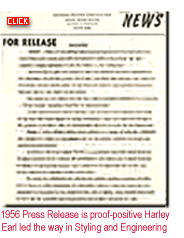
| GM'S CURRENT MODERN CULTURE ENTIRELY MISSES THIS HISTORY "It took half-a-century for Harley Earl's legacy to unravel, and America's auto world along with it (1959-2009), hopefully it won't take that long to rebuild it," says Clyde Hensley ex product design expert of GM's Media Archives. The
auto industry's downfall has been written about ad infinitum, but notably absent
from the dialogue is the causal relationship The most unbiased and factually accurate way to glean a detailed understanding of the practices and principles Earl created within GM (rather than the scant, surface understanding circulating within the industry today) is to simply read articles from the era. The three pieces on this page (articles below) do just that, and the wording of the titles alone encapsulate the nature and influence of this key player of the modern mid-twentieth century American Style movement. "Style Czar" is perhaps the most fitting term in that the position encompasses myriad functions. Whereas today's industry clearly delineates design and engineering, the seamless merging of the two was one of Earl's calling cards. Mr. Earl likened car designers to architects because they operate as both designer and engineer, and his respect for and understanding of the profession led him to wisely choose the father/son architectural team of Elio and Eero Saarinen to build what LIFE magazine dubbed in 1956 as the, "Versailles of Industry," the GM Technical Center. Good design, be it a car, a building, or a toaster, was deeply respected, and the level of design excellence emerging from America's auto scene was a source of national pride and international inspiration. These were truly exciting times and America's auto capital was being heralded in the media as the, "Design Capital of the U.S.A." By
his career's end in '58, Harley Earl truly had fulfilled his dream of creating
Detroit's dependency on design, and that he'd created what essentially became
GM's lifeblood was a fact widely recognized in his era, as these and scores of
other articles from the era demonstrate.
Where
things really get interesting, however (as well as convoluted/ misunderstood) is
that Earl never personally claimed credit for this; rather, he redirected –
or, more accurately, deflected - credit to his team and company in order to
create and maintain secrecy. As the articles included show, even as they herald
him, they're only able to do so in the most general of ways because of how
closely Earl guarded his Styling department's trade secrets. In
1937, Earl changed the name of GM's "Art & Colour" division to
"The Styling Section," a move that indicated not just his degree of
influence in the company (naming anything was a highly coveted honor and by this
time he and his team were naming all What
happened within Styling was the polar opposite of putting finishing touches on a
solidly engineered car. Rather, Styling housed the greatest new branch of
auto-building: the Body
Development Studios for
Cadillac, Buick, Chevrolet, Pontiac and Oldsmobile, as well as GMC trucks, buses
and EMD's trains. It's perhaps the biggest coup to every happen inside the auto
world whereby the Car Design Profession was birthed without anyone even
realizing it'd been delivered. (It's worth noting that just as he titled his
hybrid design and engineering studio "Styling," he publicly titled
himself as a Stylist, rather than Engineer, see term at left. The murkier Earl's job description,
the safer trade secrets were, and while in his day it was generally understood
he operated as both - see it underlined in his obituary here - over time people took his job
title increasingly literally and today he's erroneously known solely as a
Stylist.) Styling became the heart behind the creation of all of GM's future product designs (and all modern auto makers after WW Two followed suit, creating a hybrid design and engineering studio) and Earl’s streamlined process enabled production to occur in unprecedented volume – something that was soon to play a much bigger role in our nation’s history than even Harley ever imagined. SECRET
ENGINEERING
WORLD By
the late 1930s, the possibility of World War loomed large and the top cadre of
leaders at what was now the world’s largest company – General Motors –
understood that Earl’s pioneering methods had positioned them to become a
formidable asset to the Sharing
Earl's new secretive building techniques and information did two things. One, it
secured numerous, lucrative military contracts, and, two, Earl and his division
now had the unbridled strength of the U.S. military protecting their secret
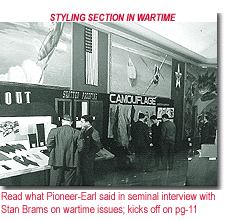
engineering world. In a 1953 interview (click link at left -- coming -- and read
his words at end of pg-12), Harley told an anecdote where, after attending a
luncheon inside GM Styling for 100 military leaders and then touring Earl's new
engineering facility, one of the generals said, "I want Army officers on
each door until we decide what we're going to do. I don't want anybody to come
in or out of this place. I want to lock it up!" For a man as secret and
enigmatic as Harley Earl, what better protection could you ask for? This
collaboration marked the beginning of a relationship between General Motors and
the The
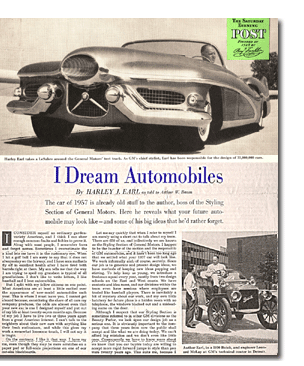
following 1954 Saturday Evening Post magazine article (snippet below)
written by Harley
Earl goes a long way explaining where the modern roots and traditions of the Most Americans are at least a little excited over the appearance of new-model automobiles each year. This is where I must leave you. I cannot get aboard because, considering the share of all cars my company produces, the odds are almost even that your new car is one I designed myself and put out of my life at least twenty-seven months ago. Because of my job, I have to live two or three years apart from a great American interest. I can’t talk to the neighbors about their new cars with anything like their fresh enthusiasm, and while this gives my work a somewhat lonesome touch, I will not say it's tragic. Let me say quickly that when I refer to myself I am merely using a short cut to talk about my team. There are 650 of us, and collectively we are known as the Styling Section of General Motors. I happen to the founder of the section and the responsible head, but we all contribute to the future appearance of GM automobiles, and it hasn’t been too long ago that we settled what your 1957 car will look like. We work informally and, of course, secretly. Since our job is to generate and present design ideas, we have methods of keeping new ideas popping and stirring. To help keep us young, we introduce a freshman squad every year, mostly from two design schools on the East and West coasts. We have contests and idea races, and our divisions within the team even have sessions where employees are traded like baseball players. There is inevitably a bit of mystery about our work, and my own little hatchery for future plans is a hidden room with no telephone, the windows blacked out and a misleading name on the door. I attended Stanford University and studied engineering. The other two
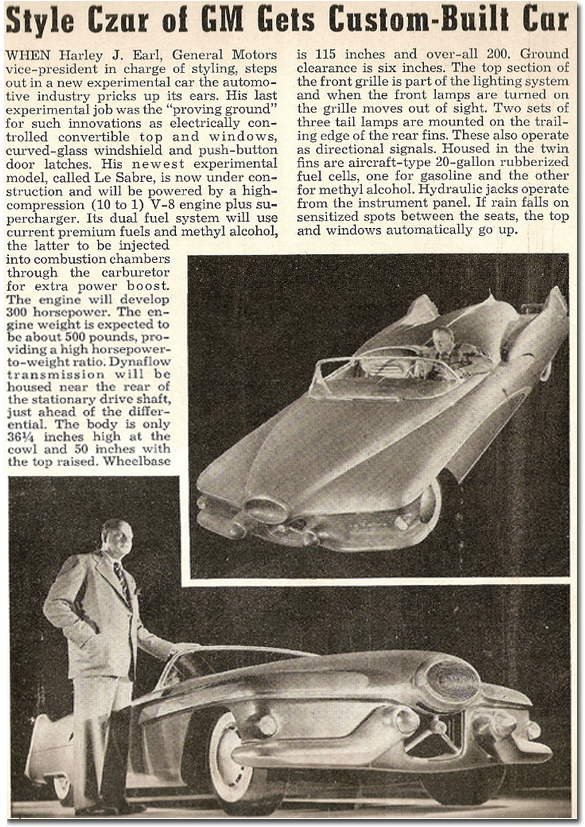
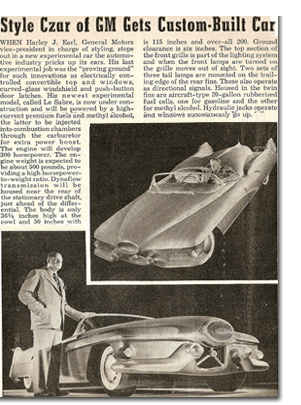
Harley Earl news articles, below, continue demonstrating how Pioneer-Earl
always played the Earl springs most of his big styling surprises with full knowledge that the first impression of a new car is the all-important one. He conceals some of his pet projects until the most opportune moment, using as his hiding place the Special Automobile Design Studio, his own personal sanctum inviolate of even to the company president, C. E. Wilson. No one, except its four designers, are allowed in the place where Earl molds his own private dreams of automobiles that become sheet-metal climaxes on the assembly line. So jealous does he guard his secrets that once, when an outsider was let in to repair the floor, the designer in charge got a thorough chewing. A janitor is permitted to clean up occasionally, but enters only after the hush-hush projects are covered with sheets. 1956
New York Times article, Along The
Highways And Byways of Finance by business writer Carl Spielvogel: Alfred P. Sloan Jr., now chairman of the board, gave him his only instructions: "make these cars to sell." In carrying out this order, " I became the most hated man in the place, because I got in everyone's hair." Officially, Mr. Earl is vice president in charge of the Styling staff at GM. Besides cars, he designs trucks, buses, earth moving equipment, home appliances, accessories, Frigidaires and the Motorama shows. He also designed the new Aerotrains and the first Train of Tomorrow with an astrodome on top." "What is being cooked up for GM’s 1959 line, which is a quarter of the way finished, is a closely guarded secret,' Mr. Earl remarks." Picture caption: DREAMER-IN-CHIEF: Harley J. Earl and heads of his GM styling staff discussing new ideas for the company's 1959 line of automobiles.
____
ENGINEERING CZAR During
Earl's 31-year tenure at GM, no other engineers had a blank
check to build an endless stream of astronomically expensive experimental custom cars
"from the tire treads up" said Harley that among other things, were
boldly used to represent the company in the public eye. This is a well documented fact, so why is it so
hard for people today to realize Harley Earl was Detroit's top dog engineer
before, during In
the decades after Earl retired, Detroit's stylists/car designers lost a lot of
"creative control" ground when the traditional
Detroit engineers inside GM and her
other major competitors of Ford and Chrysler waged war against them in order to
climb back up
the totem pole structure of power to gain control of Motown's "product designs."
The war waged by the traditional engineers came at any cost, even if it meant
taking Motown back to the ways of the 1920s, prior to Earl's arrival on the
scene, when Engineer's ruled the body building process. By the mid-1980s they certainly had
gained ground, reaffirming a more
dominant foothold next to all these company's car designers, but the ongoing Car Designers
vs Traditional Engineers battle took a huge toll on the look, feel and quality of all the Big-3's
cars, not to mention reeking havoc on these company's market share positions in
the global automotive economy during the decade's long slide. Even though things
are simmering right now in the new millennia of Detroit, the unharmonious below-the-surface interface
between the two factions remains unsettled who's on top.
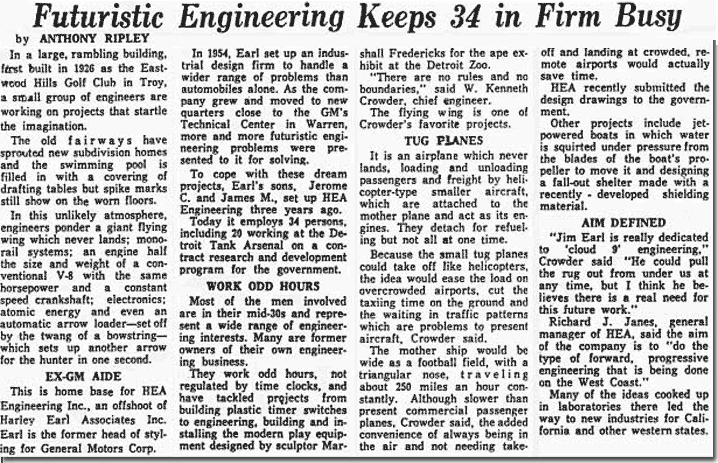
Detroit News 1961 article on 'CLOUD 9' engineering firm H.J. Earl started for his two sons; note military contract w/ Detroit Tank Arsenal.
Visit the late great Style Czar's design palace that the media hailed as the, "Versailles of Industry"
|



























 between Earl's lost legacy and the
industry's decline. It's
a classic case of not knowing what it is you don't know, and because Earl played
such a critical role in creating GM's behemoth success, there needs to be a
contemporary understanding of his career contributions if Detroit
hopes to recreate that level of success.
between Earl's lost legacy and the
industry's decline. It's
a classic case of not knowing what it is you don't know, and because Earl played
such a critical role in creating GM's behemoth success, there needs to be a
contemporary understanding of his career contributions if Detroit
hopes to recreate that level of success.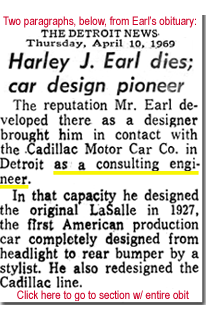
 car
design profession began along with keeping his area of expertise anonymous:
car
design profession began along with keeping his area of expertise anonymous: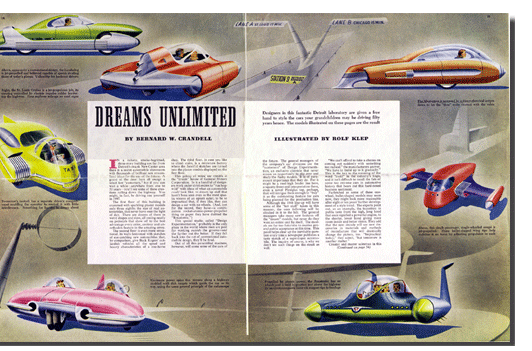 mystery man and only let a mere sliver of his, and GM's,
favored providence of invention go public. June 1947 COLLIERS magazine
article titled Dreams Unlimited, shown here, details a number of way-down-the-road
vehicle designs from GM Styling's dream house:
mystery man and only let a mere sliver of his, and GM's,
favored providence of invention go public. June 1947 COLLIERS magazine
article titled Dreams Unlimited, shown here, details a number of way-down-the-road
vehicle designs from GM Styling's dream house: 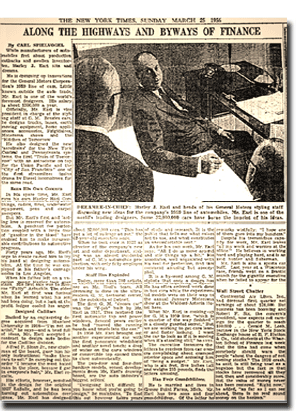 While
manufacturers of automobiles fret about production cutbacks and swollen
inventories, Harley J. Earl sits and dreams.
While
manufacturers of automobiles fret about production cutbacks and swollen
inventories, Harley J. Earl sits and dreams.